Thursday, 4 November 2021

True Comics #01 - #84 ( 1941-1950) Parents' Magazine Press - Complete Series

Parents' Magazine Press, 1941 Series

Publication information: 

Publisher The Parents' Institute
Schedule Monthly, then bi-monthly
Format: Ongoing series
Genre: Historical
Publication date: April 1941 – August 1950
No. of issues 84
Editor(s) David T. Marke
Ralph O. Ellsworth

Authors: 

Script
Hendrik Willem van Loon, Nathaniel Nitkin, Lowell Thomas
Pencils
Hendrik Willem van Loon, Edwin Smalle Jr., John Daly, 
Harold De Lay, Bernard Flinton; Harry Ramsey, Henry Kiefer
Logan Reavis, Michel Roy [Mike Roy],
Inks
Hendrik Willem van Loon ?, John Daly ?, Bernard Flinton; Harry Ramsey
Harold De Lay ?, Henry Kiefer ?, Michel Roy [Mike Roy],

True Comics is an educational comic book series published by The Parents' Institute, whose main publication was Parents' Magazine. The series ran for 84 issues, from April 1941 until August 1950, when Parents' cancelled all of their comic book series. True Comics was the most successful, or at least longest-running educational comic book series, and spawned several imitators, including DC Comics' Real Fact Comics. The series embraced the motto of "truth is stranger than fiction," and attempted to demonstrate that children would prefer "real fact" stories over fictionalized ones. By its cancellation in 1950, Parents' had rolled at least 4 of its cancelled solo comics series into True Comics.

Publication history

George J. Hecht, founder and publisher of Parents' Magazine, introduced True Comics in the aftermath of an attack on comic books by Sterling North, a children's author. In his position as a columnist at the Chicago Daily News, North published an invective against comic books titled "A National Disgrace," where he referred to comic books as "graphic insanity" and "sex-horror serials." Charging parents and teachers with "breaking the comic book," North suggested that children be furnished with proper works of literature to dissuade them from reading comic books.

Clara Savage Littledale, an editor at Parents', introduced the series as part of a March 1941 article titled "What To Do About the 'Comics'?" True Comics, close to North's intentions, 
was to provide a wholesome substitute of a comic book for children.
 In the introduction to True Comics #1, Hecht wrote,

As you all know there are many comic magazines. Originally the comic strips in newspapers and the comic magazines tried to be funny, and in a few cases succeeded. But nowadays most of the comic magazines no longer even try to be funny. They consist largely of exciting picture stories which everyone recognizes as not only untrue but utterly impossible. We are happy to present herewith a new and thoroughly different comic magazine. Lord Byron write many years ago: "T is strange, but true; for truth is always strange--Stranger than fiction." We have adopted as the slogan of True Comics, "Truth is stranger and a thousand times more interesting than fiction!" We are sure that you will agree after reading this issue.

— George J. Hecht, True Comics #1

True Comics was also one of, if not the first comic book series to have an editorial board overseeing its content. As historian Jill Lepore said in her work The Secret History of Wonder Woman, "...what really set True Comics apart was that it was overseen by an editorial advisory board of experts: professors, especially historians, educators, and even the public-opinion pollster George Gallup."

From Wikipedia, the free encyclopedia


Sunday, 31 October 2021

Unusual Tales #01 - #49 (1955 - 1965) Complete Series [Charlton Comics Collection]


Charlton, 1955 Series
Published in English (United States) United States
Publication Dates:  November 1955 - March-April 1965
Number of Issues Published:  49 (#1 - #49)
Color:  Color
Dimensions:  Standard Silver Age US
Paper Stock:  Glossy cover; Newsprint interior
Binding:  Saddle-stitched
Publishing Format:  Was ongoing
Publication Type:  magazine
Pages:  36  Indicia Frequency:  bimonthly

Tracking:
numbering continues with Blue Beetle (Charlton, 1965 series) #50

Note:
Both continuations of Unusual Tales confirmed in indicia, Blue Beetle's volume is 3 because it is Charlton's third Blue Beetle series.

Numbering continues with Shadows from Beyond (Charlton, 1966 series) #50

Note:
Both continuations of Unusual Tales confirmed in indicia, Shadows from Beyond is volume 2 incrementing from Unusual Tales' volume 1


Authors:
Script
Joe Gill ?

Pencils
Marc Swayze ?, Bill Molno ?, Dick Giordano (signed), 
Maurice Whitman ?, Charles Nicholas ?,

Inks
Marc Swayze ?, Vince Alascia, Dick Giordano (signed), 
Sal Trapani, Marc Swayze ?, Ray Osrin ?, 

Letters
Jon D'Agostino


Thursday, 28 October 2021

Shadows From Beyond #050 - One Shot [Charlton Comics Collection]


Charlton, 1966 Series
Published in English (United States) United States
 
Publication Date:  October 1966
Number of Issues Published:  1
Color:  Color
Dimensions:  Standard Silver Age US
Paper Stock:  Glossy cover; Newsprint interior
Binding:  Saddle-stitched
Publishing Format:  One-shot
Publication Type:  magazine
Pages: 36    Indicia Frequency: Four Times Yearly

Tracking:
numbering continues from Unusual Tales (Charlton, 1955 series) #49

Notes:
- Both continuations of Unusual Tales confirmed in indicia, Shadows from Beyond is volume 2 incrementing from Unusual Tales' volume 1

- Unusual Tales split into this title and Blue Beetle (Charlton, 1966 series). That resulted in two #50s; a volume 2 (Shadows from Beyond) and a volume 3 (Blue Beetle).

Authors: 

Script: Joe Gill ?
Pencils: Pat Masulli ?, Mo Marcus ?, Steve Ditko (signed)
Inks: Pat Masulli ?,  Dick Giordano ?, Steve Ditko (signed)
Letters: typeset


Link 👇

Monday, 25 October 2021

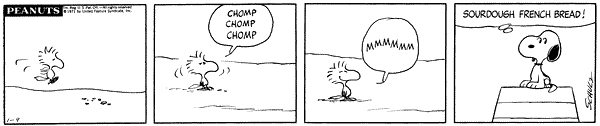
Peanuts [The Complete D.C.P.eanuts] 1987 -1999 / Peanuts Various. Charles M. Schulz


  Peanuts is a syndicated daily and Sunday American comic strip written and illustrated by 

Charles M. Schulz, which ran from October 2, 1950, to February 13, 2000, continuing in reruns afterward. The strip is one of the most popular and influential in the history of comic strips, with 17,897 strips published in all, making it “arguably the longest story ever told by one human being”. 
At its peak, Peanuts ran in over 2,600 newspapers, with a readership of 355 million in 75 countries, and was translated into 21 languages. It helped to cement the four-panel gag strip as the standard in the United States, and together with its merchandise earned Schulz more than $1 billion. 
Reprints of the strip are still syndicated and run in almost every U.S. newspaper.


Peanuts comic strips

Years 1987 -1999

350 pages each year (approximately)

Compiled by Saint Malaclypse


THE END

Link👇

Thursday, 21 October 2021

Peanuts [The Complete D.C.P.eanuts] 1971 -1986 - Charles M. Schulz

  Peanuts is a syndicated daily and Sunday American comic strip written and illustrated by 

Charles M. Schulz, which ran from October 2, 1950, to February 13, 2000, continuing in reruns afterward. The strip is one of the most popular and influential in the history of comic strips, with 17,897 strips published in all, making it “arguably the longest story ever told by one human being”. 
At its peak, Peanuts ran in over 2,600 newspapers, with a readership of 355 million in 75 countries, and was translated into 21 languages. It helped to cement the four-panel gag strip as the standard in the United States, and together with its merchandise earned Schulz more than $1 billion. 
Reprints of the strip are still syndicated and run in almost every U.S. newspaper.


Peanuts comic strips

Years 1971-1983

350 pages each year (approximately)

Compiled by Saint Malaclypse


Link👇

Related Posts Plugin for WordPress, Blogger...