Peanuts is a syndicated daily and Sunday American comic strip written and illustrated by
Charles M. Schulz, which ran from October 2, 1950, to February 13, 2000, continuing in reruns afterward. The strip is one of the most popular and influential in the history of comic strips, with 17,897 strips published in all, making it “arguably the longest story ever told by one human being”.
At its peak, Peanuts ran in over 2,600 newspapers, with a readership of 355 million in 75 countries, and was translated into 21 languages. It helped to cement the four-panel gag strip as the standard in the United States, and together with its merchandise earned Schulz more than $1 billion.
Reprints of the strip are still syndicated and run in almost every U.S. newspaper.
Peanuts achieved considerable success with its television specials, several of which, including A Charlie Brown Christmas and It’s the Great Pumpkin, Charlie Brown, won or were nominated for Emmy Awards. The holiday specials remain popular and are currently broadcast on ABC in the U.S. during the corresponding seasons. The Peanuts franchise met acclaim in theatre, with the stage musical You’re a Good Man, Charlie Brown being a successful and often-performed production. peanuts07

Peanuts has been described as “the most shining example of the American success story in the comic strip field”[citation needed]; this is ironic, given its theme is “the great American unsuccess story.” The main character, Charlie Brown, is meek, nervous, and lacks self-confidence. He is unable to fly a kite, win a baseball game, or kick a football. In 2013, TV Guide ranked the Peanuts television specials the fourth Greatest TV Cartoon of All Time. A computer-animated feature film based on the strip, The Peanuts Movie, will be released on November 6, 2015.
Characters

Charlie Brown
Charlie Brown is a young boy. He is the main character, acting as the center of the strip's world and serving as an everyman. While seen as decent, considerate, and reflective, he is also awkward, deeply sensitive, and said to suffer from an inferiority complex. Charlie Brown is a constant failure: he can never win a ballgame; he can never successfully fly a kite. His sense of determination regardless of the certainty of failure can either be interpreted as self-defeating stubbornness, or admirable persistence. When he fails, however, he experiences pain and anguish through self-pity. The journalist Christopher Caldwell observed this tension between Charlie Brown's negative and positive attitudes, stating: "What makes Charlie Brown such a rich character is that he's not purely a loser. The self-loathing that causes him so much anguish is decidedly not self-effacement. Charlie Brown is optimistic enough to think he can earn a sense of self-worth." Schulz named Charlie Brown after a colleague of his while working at Art Instruction, whose full name was Charlie Francis Brown.
Readers and critics have explored the question as to whether Schulz based Charlie Brown on himself. This question often carried the suggestion that the emotionally sensitive and depressed behaviour of Charlie Brown drew from Schulz's own life or childhood experiences. Commenting on the tendency of these conclusions being drawn, Schulz said in a 1968 interview that "I think of myself as Charles Schulz. But if someone wants to believe I'm really Charlie Brown, well, it makes a good story." He explained in another interview that the comic strip as a whole is a personal expression, and so it is impossible to avoid all the characters presenting aspects of his personality. Biographer David Michaelis made a similar conclusion, describing Charlie Brown as simply representing Schulz's "wishy-washiness and determination". Regardless, some profiles of Schulz confidently held that Charlie Brown was based on him.
Snoopy
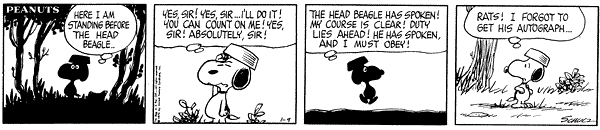
Snoopy is a dog, who later in the development of the strip would be described as a beagle.While generally behaving like a real dog and having a non-speaking role, he connects to readers through having human thoughts. He introduces fantasy elements to the strip by extending his identity through various alter egos. Many of these alter egos, such as a "World-Famous" attorney, surgeon or secret agent were seen only once or twice. His character is a mixture of innocence and egotism; he possesses childlike joy, while on occasion being somewhat selfish. He has an arrogant committent to his independence, but is often shown to be dependent on humans. Schulz was careful in balancing Snoopy's life between that of a real dog, and that of a fantastical character. While the interior of Snoopy's doghouse is described in the strip as having such things as a library and a pool table and being adorned with paintings of Wyeth and Van Gogh, it was never shown: it would have demanded an inappropriate kind of suspension of disbelief from readers.

Linus and Lucy
Linus and Lucy are siblings; Linus is the younger brother and Lucy is the older sister.
Lucy is bossy, selfish and opinionated, and is used to deliver commentary on offence and honesty, as well as sarcasm. Schulz described Lucy as full of misdirected confidence, but having the virtue of being capable of cutting right down to the truth. He said that Lucy is mean because it is funny, particularly because she is a girl: he posited that a boy being mean to girls would not be funny at all, describing a pattern in comic strip writing where it is comical when supposedly weak characters dominate supposedly strong characters. Lucy at times acts as a psychiatrist and charges five cents for psychiatric advice to other characters (usually Charlie Brown) from her "psychiatric booth", a booth parodying the setup of a lemonade stand. Lucy's role as a psychiatrist has attracted attention from real-life individuals in the field of psychology; the psychiatrist Athar Yawar playfully identified various moments in the strip where her activities could be characterised as pursuing medical and scientific interests, commenting "Lucy is very much the modern doctor".
Linus introduces intellectual, spiritual and reflective elements to the strip. He offers opinions on topics such as literature, art, science, politics and theology. He possesses a sense of morality and ethical judgment that enables him to navigate topics such as faith, intolerance, and depression. Schulz enjoyed the adaptability of his character, remarking he can be "very smart" as well as "dumb".[71] He has a tendency of expressing lofty or pompous ideas that are quickly rebuked.[66] He finds psychological security from thumb sucking and holding a blanket for comfort, referred to as his "security blanket". The idea of his security blanket originated from Schulz's own observation of his first three children, who carried around blankets. Schulz described Linus' blanket as "probably the single best thing that I ever thought of". He was proud of its versatility for visual humor in the strip, and with how the phrase "security blanket" entered the dictionary.
Peppermint Patty and Marcie
Peppermint Patty and Marcie are two girls who are friends with each other. They attend a different school from Charlie Brown, on the other side of town, and so represent a slightly different social circle from the other characters.
Peppermint Patty is a tomboy who is forthright, loyal, and has what Schulz described as a "devastating singleness of purpose". She frequently misunderstands things, to the extent that it serves as the premise of many individual strips and stories; in one story she prepares for a "skating" competition, only to learn with disastrous results that it is for roller skating and not ice skating. She struggles at school and with her homework, and often falls asleep in school. The wife of Charles Schulz, Jean Schulz, suggested that this is the consequence of how Peppermint Patty's single father works late; she stays awake at night waiting for him. In general, Charles Schulz imagined that some of her problems were from having an absent mother.
Marcie is bookish, and a good student. Schulz described her as relatively perceptive compared to other characters, stating that "she sees the truth in things". The writer Laura Bradley identified her role as "the unassuming one with sage-like insights".
https://en.wikipedia.org/wiki/Peanuts

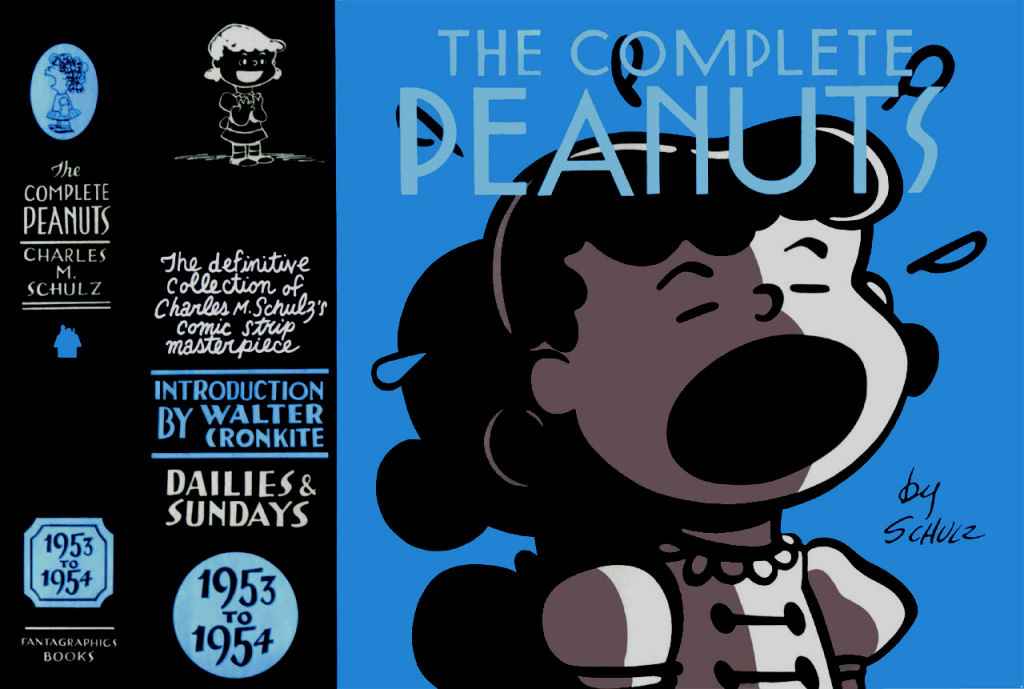
Published by Fantagraphics Books (N.Y.)
2004 - 366 pages each
Link👇