Wednesday, 21 November 2018

The Fiction House Comics Story [Links to all collections Includes]


Fiction House


Fiction House was an American publisher of pulp magazines and comic books that existed from the 1920s to the 1950s. It was founded by John B. "Jack" Kelly and John W. Glenister.
 By the late 1930s, the publisher was Thurman T. Scott. Its comics division
 was best known for its pinup-style good girl art, as epitomized by the company's most popular character, Sheena, Queen of the Jungle.


The company's original location was 461 Eighth Avenue in New York City. At the end of 1929, a New York Times article referred to 
John B. Kelly as "head" of Fiction House, Inc., and a new location of 271 Madison Avenue.

In late 1932, John W. Glenister was president of Fiction House and his son-in-law, Thurman T. Scott, was secretary of the corporation. By the end of the 1930s Scott had risen to the title of publisher.

In January 1950, the Manhattan-based company signed a lease for office space at 130 W. 42nd Street.

History


Pulp fiction

Fiction House began in 1921 as a pulp-magazine publisher of primarily aviation, Western, and sports pulps.According to co-founder John W. Glenister:


In association with J. B. Kelly, I put out our first fiction magazine devoted to adventure stories. That was in 1921. Within four years the magazine sold 150,000 copies an issue and we began four other outdoor magazines and several others."
During their first decade the company produced pulp magazines such as Action Stories, Air Stories, Lariat Stories, Detective Classics, The Frontier, True Adventures, Wings, and Fight Stories. Fiction House occasionally acquired other publishers' magazines, such as its 1929 acquisition of Frontier Stories from Doubleday, Doran & Co.

By the 1930s, the company had expanded into detective mysteries. In late 1932, however, in the midst of the Great Depression, Fiction House cancelled 12 of its pulp magazines — Aces, Action Novels, Action Stories, Air Stories, Detective Book Magazine, Detective Classics, Fight Stories, Frontier Stories, Lariat, Love Romances, North-West Stories and Wings — with the stated goal of eventually reviving them.

After a very short hiatus, Action Stories resumed publishing through this period (lasting until the fall of 1950). In addition, Fiction House relaunched its pulp magazines in 1934, finding success with a number of detective and romance pulp titles. The cancelled pulps Fight Stories and Detective Book Magazine were revived in spring 1936 and in 1937 respectively, with both magazines publishing continuously into the 1950s. Fiction House's first title with science fiction interest was Jungle Stories, which was launched in early 1939; it was not primarily a science fiction magazine, but often featured storylines with marginally science fictional themes, such as survivors from Atlantis.
At the end of 1939 Fiction House decided to add an sf magazine to its line up; it was titled
Planet Stories, and was published by Love Romances, a subsidiary company that Fiction House created to publish the company's romance titles.


List of Fiction House pulps

Aces [3]
Action Novels[3]
Action Stories (225 issues, September 1921 - Fall 1950)
Air Stories [3]
Detective Book Magazine (65 issues, Apr. 1930–Sept. 1931; 1937–Winter 1952/1953)
All Adventure Action Novels
All-American Football Magazine
Baseball Stories
Basketball Stories
Black Aces
Bull's-Eye Detective
Bull's-Eye Sports
Bull's-Eye Western Stories
Civil War Stories
Detective Classics [3]
Fight Stories (47 issues, June 1928 – May 1932; 59 issues, Spring 1936 - Spring 1952)
Football Action
Football Illustrated Annual
Football Stories
Frontier Stories[3]
George Bruce's Aces (Glen-Kel)
George Bruce's Air Novels
Jungle Stories
Lariat[3]
Love Romances[3]
North-West Romances
North-West Stories
Planet Stories (71 issues, Dec. 1939 - June 1955)
Soldier Stories
Tops in Science Fiction (2 issues, Spring–Fall 1953) — vehicle to reprint stories from Planet Stories
True Adventures
Two Complete Detective Books (Real Adventure)
Two Complete Science-Adventure Books (11 issues, 1950–1954)
Two Western Books
Two Western Romances
Wings (133 issues [11+ volumes], Jan. 1928–Spring 1953)


List of Fiction House Comic Books (selected)

"The Big Six"

Fight Comics (86 issues, Jan. 1940–[Jan.] 1954)
Jumbo Comics (167 issues, Sept. 1938–Mar. 1953)
Jungle Comics (163 issues, Jan. 1940–Summer 1954)
Planet Comics (73 issues, Jan. 1940–Winter 1953)
Rangers of Freedom Comics / Rangers Comics (69 issues, October 1941–Winter 1953)
Wings Comics (124 issues, Sept. 1940–1954)

Other titles

3-D Circus (1 issue, 1953)
Cowgirl Romances (12 issues, 1950–Winter 1952/1953)
The First Christmas (1 issue, 1953; 3-D)
Ghost Comics (11 issues, 1951–1954)
Indians (17 issues, 1950–1953)
Ka'a'nga, Jungle King (20 issues, Spring 1949–Summer 1954)
Long Bow (9 issues, 1951–Winter 1952/1953)
Man O' Mars (1 issue, 1953)
Movie Comics (4 issues, Dec. 1946–1947)
Pioneer West Romances / Firehair (11 issues, Spring 1950–Spring 1952)
Sheena, Queen of the Jungle (18 issues, Spring 1942–Winter 1952/1953)
The Spirit (5 issues, 1952–54)
Wambi, Jungle Boy (18 issues, Spring 1942–Winter 1952)


Bob Lubbers | PAUL GRAVETT


Links to all collections posted on Old-fashioned Comics

https://old-fashionedcomics.blogspot.com/search/label/Fiction%20House%20Comics%20Collection


Monday, 19 November 2018

The Arrow #01 - #03 (1940 - 1941) Centaur Publications Inc. ( Complete Series)


The Arrow
Centaur, 1940 Series

Publication Dates: October (Number of Issues Published: 3 (#01 - #03)
Color:   Color
Dimensions:  Standard Golden Age U. S.
Paper Stock:   Glossy cover; Newsprint interior
Binding:  Saddle-stitched
Publishing Format:  Was Ongoing Series
Pages: 68 Indicia frequency: monthly

Notes
Only series known to have issues published by both Centaur Publications, Inc. (#1-2) and Comic Corporation of America (#3), albeit widely separated in time (10 months between #2 and #3).


Authors: 

Script
Paul Gustavson (signed), John F. Kolb (signed), Martin Filchock (signed), Bob Lubbers (signed)
Pencils
Paul Gustavson (signed), John F. Kolb (signed),Martin Filchock (signed),  Steve Dahlman (signed), Paul J. Lauretta (signed), Bob Lubbers (signed), Dan Gormley (signed), 
Inks
Paul Gustavson (signed), John F. Kolb (signed), Bob Lubbers (signed), Martin Filchock (signed), Steve Dahlman (signed), Paul J. Lauretta (signed), Dan Gormley (signed),
Colors
?
Letters
Paul Gustavson


Links: The Arrow #01 - #03⇲⇲

Saturday, 17 November 2018

Fleetway Super Library: Fantastic Series, Stupendous Series, Secret Agent Series, Front Line Series


Publication Dates: 1967 to 1968
Color:       Colour cover; Black and White interiors 
Binding:  Softcover 
Publishing Format:  Was ongoing 
Pages :   132         Indicia frequency:    ?


Fantastic Series

Publication Dates: January 1967 – January 1967
Number of Issues Published: 2 (#1 – #2)
Pages: 132  Indicia Frequency:  ?

Continued in Fleetway Super Library Stupendous series Fleetway Publications, 1967 series#3

Authors

Script
    Jerry Siegel    Jerry Siegel    Alessandro Biffignandi 
Pencils
Aldo Marculetta,  Alessandro Biffignandi,  Carlo Jacono (signed),  Carlos Cruz
Inks
    Aldo Marculetta, Alessandro Biffignandi, Carlo Jacono (signed), Carlos Cruz
Colors
    Carlo Jacono (signed) 


Stupendous Series

Publication Dates: February 1967 – January 1968
Number of Issues Published: 24 (#3 – #26)
Pages: 132  Indicia Frequency:  ?

Tracking:
numbering continues from Fleetway Super Library Fantastic Series (IPC, 1967 series) #2

Authors

Script
    Donne Avenell,    David MortonScript
    Ken Mennell
 Pencils
    Carlo Jacono (painted), Jesús Blasco, Giorgio Trevisan, Carlos Cruz,
 Francisco Cueto,  Aldo Marcuzzi, 
Inks
    Carlo Jacono (painted), Jesús Blasco, Giorgio Trevisan, Carlos Cruz, 
 Aldo Marcuzzi, Francisco Cueto, 
Colors
    Carlo Jacono (painted)


Secret Agent Series

Publication Dates: January 1967 – January 1968
Number of Issues Published: 26 (#1 – #26)

Script  ?  Pencils ?  Inks ?  Letters ?
Front Line Series

Publication Dates:   January 1967 - January 1968 
Number of Issues Published:    26 (#1 - #26)
Pages: 132  Indicia Frequency:  ?


Script  ?  Pencils ?  Inks ?  Letters ?


Fleetway Super Library was a comic published by Fleetway from 1967 to 1968. 
As its title suggests it followed the picture library format, albeit on a chunkier scale than usual:
 each issue was 
132 pages long, containing a 122-page main story alongside back-up material 
such as a quiz or reprints of humour strips.
The Fleetway Super Library series was itself split into three smaller series, each with two protagonists. Stupendous, which was called Fantastic during the first month 
of its existence, 


followed the exploits of the Steel Claw (from Valiant) and the Spider (from Lion);
 the military-themed Front Line starred Maddock’s Marauders and 
Top-Sergeant Ironside
both of whom would migrate to Battle Picture Library following the demise of Super Library; 
and finally Secret Agent told the stories of Johnny Nero and the Lion hero Barracuda.
Super Library was not long-lived: it ended in January 1968 after a total of 78 issues, 
26 for each sub-series. 
Steve Holland has argued that it could 
be regarded as Britain’s first series of graphic novels.


Fleetway Super Library Fantastic Series #1 - #2 Complete Series
Fleetway Super Library Front Line Series #01 - #26   Numbers 1-4, 7 ,9, 11, 13-15 & 17-19 are missing
Fleetway Super Library Secret Agent Series #01 - #26   Numbers  4, 6, 8, 10, 11 &  20 are missing
Fleetway Super Library Stupendous Series #03 - #26  Complete Series


Thursday, 15 November 2018

Ramar of the jungle #02–#05 (1955–1956) Charlton, #01 (1954) Toby - Complete Series [Charlton Comics Collection]


1955 Serie

Publisher: Charlton
Publication Dates: September 1955 – September 1956
Number of Issues Published: 4 (#2 – #5)
Color: Color
Dimensions: Standard Silver Age US
Paper Stock: Glossy cover; Newsprint interior
Binding: Saddle-stitched
Publishing Format: Was ongoing
Publication Type: magazine
Pages: 36           Indicia frequency: bimonthly

Numbering continues from Ramar of the Jungle (Toby, 1954 series) #1.

Authors:

Script:
 Joe Gill?
Pencils:
 Mike Sekowsky, John Belfi?[as JB], Maurice Whitman ?, Charles Nicholas,  Don Perlin?,
Marc Swayze,   Bill Molno,
Inks:
  Mike Peppe,  John Belfi?[as JB] Maurice Whitman?,  Jon D'Agostino, Sal Trapani,  Marc Swayze, Rocco "Rocke" Mastroserio,
Colors: ?
Letters:
 Jon D'Agostino,  Ed Hamilton, John Duffy.


1954 Serie

Publisher: Toby
Publication Date: 1954 (no month)
Number of Issues Published: 1
Color: color
Dimensions: standard Golden Age US
Paper Stock: glossy cover; newsprint interior
Binding: saddle-stitched
Publishing Format: one-shot
Publication Type: magazine
Pages: 36    Indicia / Colophon Publisher: Toby Press, Inc.

Numbering continues with Ramar of the Jungle (Charlton, 1955 series) #2.

Authors:

Script: ?
Pencils: Art Peddy, Nat Johnson, Al Gordon (signed)
Inks: Jack Abel?, Nat Johnson, Al Gordon (signed)
Colors: ?
Letters: Ed Hamilton, John Duffy


Links: Ramar of the jungle #02 – #05 &  Ramar of the jungle  #01 Toby ⇲⇲


Tuesday, 13 November 2018

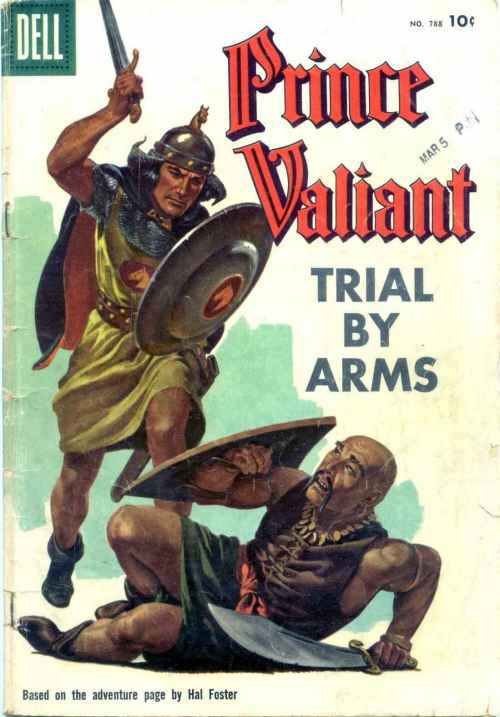
PRINCE VALIANT (Dell Four Color Comics) 7 issues (Complete Series)


Prince Valiant in the Days of King Arthur, or simply Prince Valiant, is an American long-running comic strip created by Hal Foster in 1937. It is an epic adventure that has told a continuous story during its entire history, and the full stretch of that story now totals more than 4000 Sunday strips. Currently, the strip appears weekly in more than 300 American newspapers, according to its distributor, King Features Syndicate.

Edward, the Duke of Windsor, called Prince Valiant the “greatest contribution to English literature in the past hundred years.” Generally regarded by comics historians as one of the most impressive visual creations ever syndicated, the strip is noted for its realistically rendered panoramas and the intelligent, sometimes humorous, narrative. The format does not employ word balloons. Instead, the story is narrated in captions positioned at the bottom or sides of panels. Events depicted are taken from various time periods, from the late Roman Empire to the High Middle Ages, with a few brief scenes from modern times (commenting on the “manuscript”).
( Texte: fourcolorcomicsblog


Authors: 

Covers:

 Pencils, Inks and Colors
Don Spaulding ?, Sam Savit, Franco Picchioni, Morris Gollub, George Wilson (painting)
(painting)

Comic stories

Script: Dudley Nichols (screenplay); Paul S. Newman (comic adaptation)
Pencils: Bob Fujitani
Inks: Bob Fujitani
Colors: ?
Letters: ?

Information thanks to the Grand Comics Database


PRINCE VALIANT  Comics  from Dell Four Color

fcc 567,650,699,719,788,849,900


Link: ⇲⇲

Monday, 12 November 2018

The Beano - 10 November 2018


Publisher:  D. C. Thomson & Co.
Schedule:   Weekly
Format: Ongoing
Genre:  Anthology
Children's humour
Publication date 30 July 1938 to present
No. of issues 3949 (as of 22 August 2018)

Read more »

 Issue published on November 3, 2018.
 36 pages issue.


Link ⇲⇲

Saturday, 10 November 2018

Mandrake the Magician #01 - #10 (1966-1967) King Features


1966 Series


Publication Dates:
September 1966 - November 1967
Number of Issues Published:  10 (#1 - #10)
Pages: 36
Indicia frequency: bi-monthly
Color:  Color cover and interior
Dimensions:  Standard Silver Age U.S.
Paper Stock:  Glossy cover; Newsprint interior
Binding:  Saddle-stitched
Publishing Format:  Was Ongoing Series
Publication Type:  magazine    
  

 Authors: 

Script:
    Dick Wood, Gary Poole, Paul Norris (signed), Giovanni Fiorentini.
Pencils:
    Don Heck, Andre LeBlanc,     Bill Lignante    Ray Bailey, Ray Bailey ?,  Fred Fredericks ?, 
Paul Norris,  Domenico Mirabella(signed)
 Inks:  
    André LeBlanc, Mike Peppe, Bill Lignante, Ray Bailey ?,  Fred Fredericks ?, 
 Paul Norris (signed), Domenico Mirabella
Colors:    ?
Letters:   
 Charlotte Jetter, Ben Oda   


Links: Mandrake the Magician #01 - #10 ⇲⇲

Related Posts Plugin for WordPress, Blogger...