Showing posts with label The Charlton Comics Story. Show all posts

Monday, 3 February 2025

Comic Book Artist 09 - The Charlton Comics Story (2000) / 12 - Charlton Comics Of The 1970's (2001). Contributed by Jens Terje


Comic Book Artist was an American magazine founded by Jon B. Cooke devoted 
to anecdotal histories of American comic books, with emphasis on comics 
published since the 1960s. 
It was published by TwoMorrows Publishing and later Top Shelf Productions 
from 1998–2005. 
Its sequel is Comic Book Creator magazine which started publishing in 201 
and is also published by TwoMorrows.

Comic Book Artist primarily used lengthy interviews with the artists, writers, editors 
and publishers who contributed to the indigenous American art form, often featuring
 the first comprehensive histories of such comics publishers as Warren Publishing, 
Charlton Comics, Tower Comics, Gold Key Comics, and Harvey Comics, though 
emphasis was given as well to industry leaders DC Comics and Marvel Comics.


Comic Book Artist 09 - The Charlton Comics Story (2000)


Comic Book Artist  12 - Charlton Comics Of The 1970's (2001)


Comic Book Artist 09 - The Charlton Comics Story (2000)


Thanks to Jens Terje

Friday, 17 November 2017

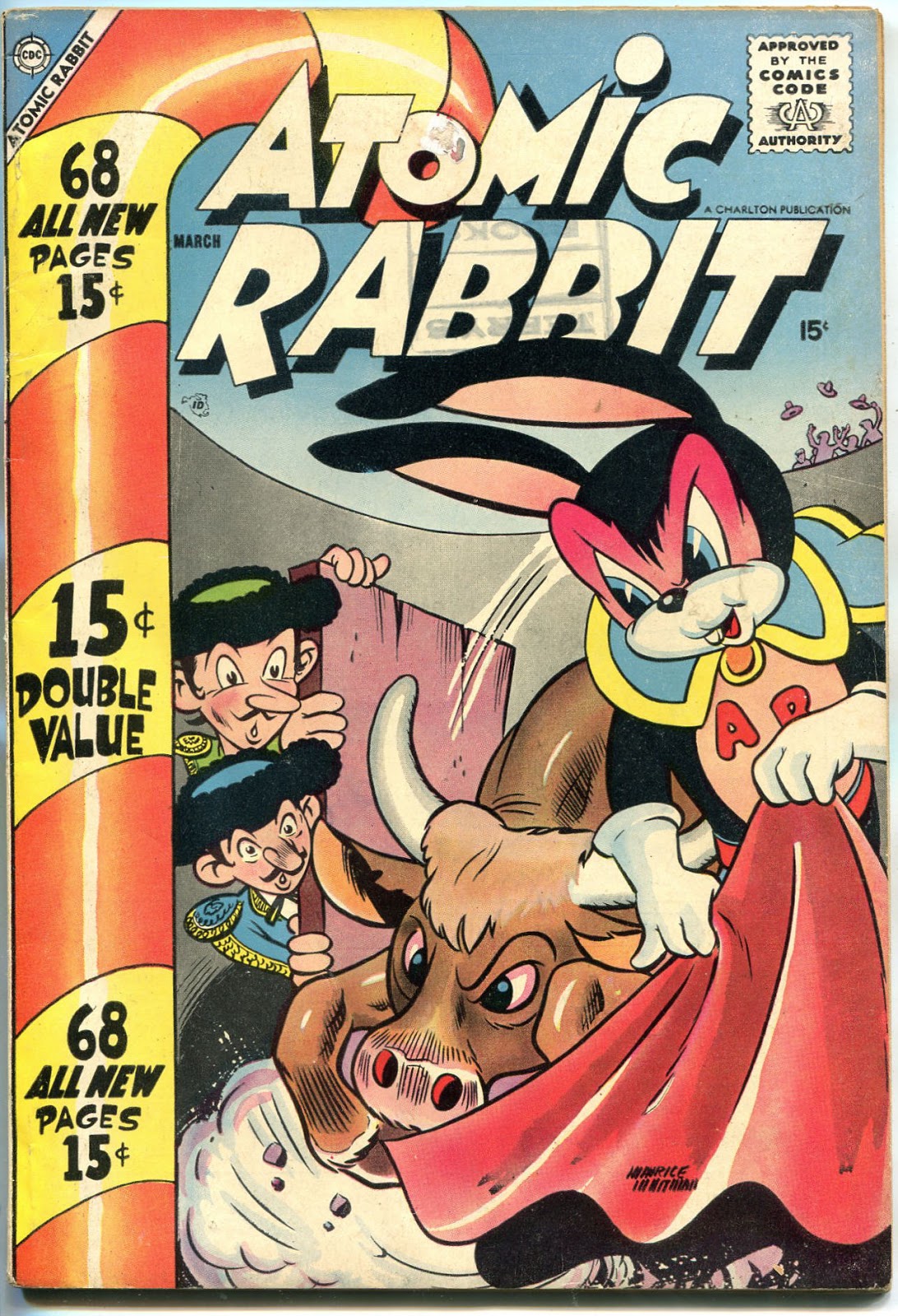
Atomic Rabbit #01 - #11 (1955- 1958) Atomic Bunny #12 - #19 (1958-1959) Complete Series [Charlton Comics Collection]


Atomic Rabbit #01 - #11 Aug 1955 - Mar 1958

Publication Dates:

  Publication history  August 1955 - March 1958 
Number of Issues Published:    11 (#1 - #11) 
Color:   Color 
Creator: Al Fago
Dimensions:   Standard Silver Age US 
Paper Stock:  Glossy cover; newsprint interior 
Binding: Saddle-stitched 
Publishing Format:   Was Ongoing 
Publication Type:  magazine
Pages 36     Indicia Frequency bimonthly

Authors: 

Pencils: Al Fago (signed) | Inks: Al Fago (signed)

Tracking

    numbering continues with Atomic Bunny #12 - #19 (Charlton, 1958 series)

Atomic Rabbit was a funny animal comic book series created in 1955 by Al Fago, following his success with Atomic Mouse from Charlton Comics. The story originates with a lonely and starving rabbit that inadvertently gains super powers by eating a radioactive carrot laced with uranium.

With the departure of Al Fago, the series was renamed Atomic Bunny in August 1958 and continued with artwork by Pat Masulli until 1960.

In 1996, American Comics Group announced the return of Atomic Rabbit, reprinted from the original proofs along with reprints of Peter Rabbit by Fago's younger brother Vincent.


Funny animal superheroes have been a part of the animation and comic book scenes since the days of Mighty Mouse and Supermouse, respectively — almost as long as human superheroes have been around, in fact. Marvel had Super Rabbit, DC had The Terrific Whatzit, Fox had Cosmo Cat etc. But the biggest concentration of the sub-genre was at Charlton Comics during the 1950s, which had Hoppy the Magic Bunny, Atom the Cat, and several others — in fact, its longest-lasting superhero title ever was Atomic Mouse. What Magazine Enterprises (Red Mask, Presto Kid) was to western heroes with secret identities, Charlton was to funny animal superheroes.

Atomic Mouse may owe his longevity to the fact that he was created by Al Fago (Neddy Bear, Timmy the Timid Ghost). While Charlton, with its low production costs and in-house distribution, was able to make a success of many properties with little apparent reader interest, such as Black Fury and Cheyenne Kid, Fago had a way of connecting with kids. Atomic Rabbit wasn't as successful, but he had the same advantage. Fago wrote and drew his stories, too.


Atomic Rabbit was a lot like Atomic Mouse, but with a species change and a couple less supporting characters. He protected Rabbitville, rather than Mouseville, from the depredations of Sly Fox, rather than Count Gatto. Instead of an inept assistant, Sly had two kids.


He, too, got his super powers from doubly-forbidden fruit by today's standards — drugs and radiation. But while both their power-enhancers were as radioactive as can be, Mouse's was more blatantly a drug. He got his super powers from U-235 pills, whereas Rabbit's U-235 carrots could be passed off as good nutrition, like Atomictot's vitamins and Popeye's spinach. But while Popeye of the E.C. Segar comics ate lots of spinach for strength through nutrition, the animated Popeye treated it like a drug, getting a huge rush from it and sometimes, just for emphasis, sucking it in through his pipe. Good nutrition or not, Atomic Rabbit definitely fell into the category of drug-based superheroes.


Fago handled Atomic Rabbit from his first appearance, dated August, 1955, through the end of the series under that name — #11, dated March, 1958. As of #12, it was changed to Atomic Bunny, and it's not certain they're the same character. Bunny looked like Rabbit in the first issue, tho drawn by Charlton's editor, Pat Masulli, but his appearance changed radically after that. Then, he was back to his former appearance with the last issue (December, 1959).


A Fago story was reprinted by Norlen Publications in 1959, Comics entrepreneur Roger Broughten, who now owns most of the old Charlton properties, published Atomic Rabbit & Friends as a oneshot in the 1990s.


Whether Charlton published one lagomorphic hero or two, it's been out of the funny animal superhero business for decades.   — DDM [www.toonopedia.com]


Atomic Bunny  #12 - 19 (1958-1959)

Publication Dates:

Publication history August 1958 - December 1959 
Number of Issues Published:    8 (#12 - #19) 
Color: Color
Dimensions: Standard Silver Age US 
Paper Stock:  Glossy cover; newsprint interior   
Binding: Saddle-stitched    
Publishing Format:    Was Ongoing 
Publication Type:   magazine 
Pages 36     Indicia Frequency Quarterly

Authors: 

Script: Joe Gill? | Pencils: George Wildman,  Pat Masulli (signed) |
Inks: George Wildman | Letters: Jon D'Agostino

Tracking

    numbering continues from Atomic Rabbit (Charlton, 1955 series) #11 


 Links ⇲⇲ Atomic Rabbit #1 - 11, Atomic Bunny  #12 - 19 


Sunday, 29 October 2017

Atomic Mouse #01 - #52 (1953 - 1962) Complete Series. The Charlton Comics Story Part 05 [Charlton Comics Collection]


Atomic Mouse
Charlton, 1953 Series

Published in English (United States) United States

Publication Dates:  March 1953 - February 1963 
Number of Issues Published:   52 (#1 - #52) 
Color: Color 
Dimensions: Standard Silver Age US 
Paper Stock:  Newsprint 
Binding: Saddle-stitched (except #26, which is Squarebound) 
Publishing Format: Was Ongoing 
Publication Type:  magazine
Pages 36     Indicia Frequency:  Bi-Monthly

Authors: 

Script:  Al Fago
Pencils:  Al Fago (signed)
Inks:  Al Fago (signed)
Colors:  ?

Note: 
Overstreet has listed #53-54, but there is no evidence they actually exist.


Atomic Mouse may have been a funny animal, but he was the most successful superhero Charlton Comics ever published. His … 54 issues, which came out between March, 1953 and June, 1963, put him way ahead of Thunderbolt, Nature Boy, E-Man (even counting post-Charlton appearances), Captain Atom (same) and even The Blue Beetle (a surprisingly long-lived character, but only for other publishers). Not one of those guys was ever in print continuously for over ten years, like Atomic Mouse was.


He was Charlton's first funny animal superhero, but far from the last. A year later the company inherited Hoppy the Magic Bunny (formerly Marvel Bunny) when Fawcett settled the Superman/Captain Marvel lawsuit with DC, and got out of the comics business. Then there were Atomic Rabbit, Atomic Bunny (who were sort of, at least, two different guys), Atom the Cat, etc. In later years, the publisher even took a turn with Thunderbunny. But as a creation of Al Fago, whose Frisky Fables had entertained young readers for years, Atomic Mouse is probably the best remembered.


Atomic Mouse got his super powers by ingesting U-235 pills, provided by Professor Invento — a double no-no by today's standards, involving both drugs and radiation. But at the time they seemed innocent enough; and they did enable him to protect the citizens of Mouseville from the evil Count Gatto and his inept sidekick, Shadow (no relation).

Like Li'l Genius, Timmy the Timid Ghost and his other contemporaries at Charlton, Atomic Mouse ran his course and disappeared, leaving no cartoons, Little Golden Books, big little books or other paraphernalia in his wake. With those other '50s Charlton characters, he was revived in reprint form during the mid-1980s; but that, too, ran its course and went away. Now, the publisher itself is no more.

Unexpectedly, tho, Atomic Mouse has been re-revived anyway. In 2001, Shanda Fantasy Arts brought out a black and white comic featuring a mixture of reprints by Fago and new stories by Mike Curtis, Charles Ettinger and other modern practitioners of the funny animal arts. In this version, he was a comic book character within the comic book, transported into comic book "reality" through judicious application of comic book science, to protect the city of Rodentia from all that may threaten it.


 Placing the old material next to the new makes a striking contrast. For one thing, in the old stories, the title character has the proportions of a funny animal (large head in relation to the rest of his body), while the new ones show him built like a superhero (smaller than average head). Still, there he is — Atomic Mouse, of all the unlikely characters, having brand-new adventures in the 21st century.

Maybe there's still hope for Super Rabbit, Fearless Fly, The Terrific Whatzit and Wiggles the Wonderworm.

[www.toonopedia.com]


The Charlton Comics Story  Part 05

Bullseye logo, used from Sept./Oct. 1973

Final years


By the 1980s, Charlton was in decline. The comic book industry was in a sales slump, struggling to reinvent a profitable distribution and retail system. Charlton's licensed titles lapsed, its aging presses were deteriorating towards uselessness, and the company did not have the resources to replace them. In 1981, there was yet another attempt at new material, with a comic book version of Charlton Bullseye serving as a new-talent showcase that actively solicited submissions by comic book fans,and an attempt at new Ditko-produced titles. A number of 1970s-era titles were also reprinted under the Modern Comics imprint and sold in bagged sets in department stores (in much the same way Gold Key Comics were published under the Whitman Comics branding around the same time). None of these measures worked, however, and in 1984 Charlton Comics suspended publication.


In 1985, a final attempt at a revival was spearheaded by new editor T. C. Ford with a direct-market Charlton Bullseye Special.But later that same year, Charlton Comics went out of business;Charlton Publications followed suit in 1991, and its building and press were demolished in 1999.


Editor Robin Snyder oversaw the sale of some properties to their creators, though the bulk of the rights was purchased by Canadian entrepreneur Roger Broughton. He would produce several reprint titles under the company name of Avalon Communications and its imprint America's Comics Group (ACG for short, Broughton having also purchased the rights to the defunct American Comics Group properties), and announced plans to restart Charlton Comics. This did not occur beyond its publishing a number of reprints and changing his company name to Charlton Media Group

Most of Charlton's superhero characters were acquired in 1983 by DC Comics, where former Charlton editor Dick Giordano was then managing editor. These "Action Hero" characters were originally to be used in the landmark Watchmen miniseries written by Alan Moore, but DC then chose to save the characters for other uses. Moore instead developed new characters loosely based on them. The Charlton characters were incorporated into DC's main superhero line, starting in the epic Crisis on Infinite Earths miniseries of 1985.
Fan revivals


In 2000, Charlton Spotlight, a fanzine devoted to Charlton, began publication.

The Charlton Arrow launched in 2014 from Charlton Neo and published through Mort Todd's Comicfix, the comic includes stories featuring Charlton characters and titles not owned by DC. In May 2017, AC Comics announced that they had entered into an agreement to bring print versions of Charlton Neo's comics to the direct sales comic shop market, starting with Charlton Arrow #1 in September.

THE END


Thursday, 12 October 2017

Atom The Cat #09 - #17 (1957) Complete Series, The Charlton Comics Story Part 04 [Charlton Comics Collection]


Atom the Cat 
 (Charlton, 1957 series)
 
Publication Dates: October 1957 - August 1959 
Number of Issues Published:   9 (#9 - #17) 
Color:Color 
Dimensions: Standard Silver Age US 
Paper Stock:
    Glossy cover; newsprint interior 
Binding:  Saddle-stitched 
Publishing Format:Was Ongoing 
Publication Type:  magazine 
Pages: 36     Indicia Frequency: Bimonthly

Authors:

Script: Joe Gill?
Pencils: Maurice Whitman (signed), George Wildman 
Inks: Maurice Whitman (signed), George Wildman
Letters: Jon D'Agostino 

Tracking

numbering continues from Tom Cat (Charlton, 1956 series)  #04 - #08


The Charlton Comics Story,  Part 04
Bullseye logo, used from Sept./Oct. 1973

Bronze Age

Nicola Cuti made creative improvements to Charlton's line in the early 1970s Bronze Age of comic books as assistant editor under George Wildman, who was occupied primarily with administrative duties. Cuti brought Mike Zeck, among others, into Charlton's roster of artists, and his writing enlivened the Ghostly titles, now including Ghostly Haunts. Other Bronze Age Charlton horror titles included Haunted, Midnight Tales, and Scary Tales.

In 1973, Charlton debuted the Gothic romance title Haunted Love, but this same period saw the mass cancellation of almost all of Charlton's vast stable of traditional romance titles, including such long-running series as Sweethearts, Romantic Secrets, Romantic Story, I Love You, Teen-Age Love, Just Married, and Teen Confessions, all of which dated from the 1950s.

In the mid-1970s, there was a brief resurgence of talent, energized by Cuti, artist Joe Staton and the "CPL Gang"—a group of writer/artist comics fans including John Byrne, Roger Stern, Bob Layton, and Roger Slifer, who had all worked on the fanzine CPL (Contemporary Pictorial Literature). Charlton began publishing such new titles as E-Man, Midnight Tales and Doomsday + 1. The CPL Gang also produced an in-house fanzine called Charlton Bullseye, which published, among other things, such commissioned but previously unpublished material as the company's last Captain Atom story. Also during this period, most of Charlton's titles began sporting painted covers.


Early in 1975, Cuti, already writing freelance for the company in addition to his staff duties, quit to write freelance exclusively for Charlton when its line expanded to include black-and-white magazines in addition to the King Features and Hanna-Barbera franchised titles. He was replaced by Bill Pearson, who became assistant editor after promoting Don Newton as the new Phantom artist and writing scripts for that title.

Charlton's black-and-white comics magazines were based upon current television series and aimed at older readers. One of these was The Six Million Dollar Man #1–7 (July 1976 – August 1977). Retailing for $1, it featured art by Neal Adams' studio, Continuity Associates, as well as some stories by veteran illustrators Jack Sparling and Win Mortimer. Also published in magazine form were adaptations of The Six Million Dollar Man spinoff The Bionic Woman, Space: 1999, and Emergency!, as well as a comic based on teen heartthrob David Cassidy, then starring in the musical sitcom The Partridge Family.


By 1976, however, most of these titles had been canceled,[10] and most of the company's remaining titles went on hiatus during the period January to August 1977. Much of the new talent took the opportunity to move on to Marvel and D.
 (To be continued...)


Link:  Atom The Cat #09 - #17 ⇲⇲

Monday, 2 October 2017

Army War Heroes #01--#38 (1963-1970) Complete Series - The Charlton Comics Story Part 03 [Charlton Comics Collection]


Publisher: Charlton
Publication Dates: December 1963 – June 1970
Number of Issues Published: 38 (#01 – #38)
Color: Color
Dimensions: Standard Silver Age US Size
Paper Stock: Newsprint
Binding: Saddle-stitched
Publishing Format: Was ongoing
Pages 36       Indicia Frequency:  bi-monthly


Authors: 

Script: Joe Gill?
Pencils: Dick Giordano?, Charles Nicholas (signed), Bill Molno, Pat Masulli?, 
 Larry Woromay
Inks: Dick Giordano,  Vince Alascia (signed),  Rocco "Rocke" Mastroserio (signed),  
M. Salito (signed) [as Salito]


Silver Age 

The company's most noteworthy period was during the Silver Age of comic books, which had begun with DC Comics' successful revival of superheroes in 1956.[2] In March 1960, Charlton's science fiction anthology title Space Adventures introduced Captain Atom, by Gill and the future co-creator of Marvel Comics' Spider-Man, Steve Ditko.(After the mid-1980s demise of Charlton, Captain Atom would go on to become a stalwart of the DC stable, as would Blue Beetle, the old Fox Comics superhero revived by Gill and artists Bill Fraccio and Tony Tallarico as a campy, comedic character in Blue Beetle #1 [June 1964].)


Charlton also had middling success with Son of Vulcan, its answer to Marvel's Thor, in Mysteries of Unexplored Worlds #46 (May 1965).
Fightin' Army #76 (Oct. 1967). Cover art by Rocke Mastroserio


During the Silver Age, Charlton, like Marvel and DC, published war comics. Notable titles included the "Fightin'" Line of Fightin' Air Force, Fightin' Army, Fightin' Marines, and Fightin' Navy; the "Attack" line of Army Attack and Submarine Attack; Battlefield Action; D-Day, U.S. Air Force Comics, and War Heroes. Though primarily anthologies of stories about 20th-century warfare, they included a small number of recurring characters and features, including "The American Eagle",[7] "Shotgun Harker and the Chicken", "The Devil's Brigade", "The Iron Corporal" and "The Lonely War of Capt. Willy Schultz". Army War Heroes and Marine War Heroes depicted stories based on actual Medal of Honor recipients.

Charlton threw itself into the resurgent horror comics genre during this period with such titles as Ghostly Tales, The Many Ghosts of Doctor Graves, and Ghost Manor. It also created a pair of identical horror-movie magazines: Horror Monsters (1961–1964) and Mad Monsters (1961–1965). Additionally, Charlton produced comics based on monsters featured in motion pictures such as Konga, Gorgo and Reptilicus.

Charlton continued its commitment to romance comics with such new titles as Career Girl Romances, Hollywood Romances (later to change its name to For Lovers Only), and Time for Love.


In 1965, Charlton revived the Captain Atom character in Strange Suspense Stories numbers 75, 76 and 77, reprinting the Steve Ditko illustrated stories which had originally appeared in Space Adventures in the early 1960s. Retitling the comic, Captain Atom Volume 2 #78 (cover dated Dec. 1965), Charlton began publishing newly created stories by Diko of the superhero. In 1967, Ditko stopped working at Marvel and returned to Charlton full-time. After his celebrated stint at Marvel, he had grown disenchanted with that company and his Spider-Man collaborator, writer-editor Stan Lee. Having the hugely popular Ditko back helped prompt Charlton editor Giordano to introduce the company's "Action Hero" superhero line, with characters including Captain Atom; Ditko's the Question; Gill and artist Pat Boyette's The Peacemaker; Gill and company art director Frank McLaughlin's Judomaster; Pete Morisi's Peter Cannon... Thunderbolt; and Ditko's new "Ted Kord" version of the Blue Beetle.[8] The company also developed a reputation as a place for new talent to break into comics; examples include Jim Aparo, Dennis O'Neil and Sam Grainger. As well, Charlton in the late 1960s published some of the first manga in America, in Ghost Manor and other titles (thanks to artist Sanho Kim), and artist Wayne Howard became the industry's first known cover-credited series creator, with the horror-anthology Midnight Tales blurbing "Created by Wayne Howard" on each issue—"a declaration perhaps unique in the industry at the time".

Yet by the end of 1967, Charlton's superhero titles had been cancelled, and licensed properties had become the company's staples, particularly cartoon characters from Hanna-Barbera (The Flintstones, The Jetsons, Top Cat, others). Charlton took over publication of a number of King Features Syndicate characters from that company's short-lived King Comics, including Beetle Bailey, Blondie Comics, Flash Gordon, Jungle Jim, The Phantom, and Popeye. Charlton also published Bullwinkle and Rocky, and Hoppity Hooper, based on Jay Ward Productions' Hoppity Hooper, and Rocky and His Friends/The Bullwinkle Show.

 (To be continued...)


Links :  #01-#38⇲⇲

Related Posts Plugin for WordPress, Blogger...